Business workflows and buyers comparing Make against direct alternatives.
Make uses a freemium model, so most users can try the core workflow first and then upgrade for higher limits, better quality, or team features.
Use Make if you specifically need visual drag-and-drop scenario builder and 1,500+ app integrations inside a business workflow. Skip Make if your main priority is broader all-in-one coverage, the lowest possible cost, or a workflow outside business.
Quick Facts About Make
Make is a freemium business AI tool by Make. It is best known for visual drag-and-drop scenario builder and 1,500+ app integrations. Best for users who need business workflows, with alternatives including Gamma, AdCreative.ai, n8n.
- Tool name
- Make
- Company
- Make
- Category
- Business
- Subcategory
- Productivity
- Pricing
- Freemium
- Official website
- https://www.make.com
- Launch year
- 2012
- Review rating
- 4.5/5 from 21,000 reviews
About Make
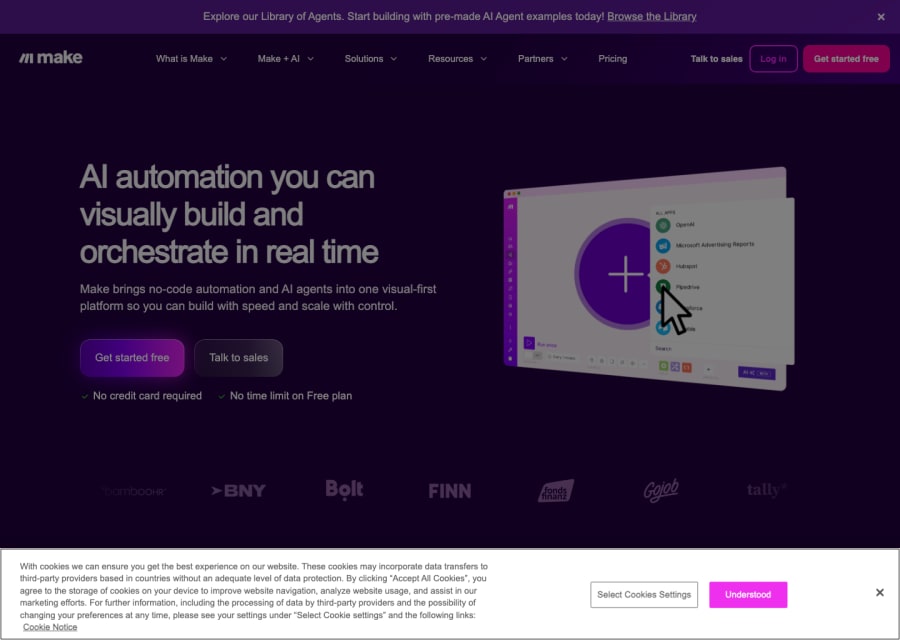
Make (formerly Integromat) is a visual automation platform that lets you design, build, and automate workflows by connecting apps with a drag-and-drop scenario editor. It supports more complex logic and data transformation than Zapier, with built-in AI operations for text analysis, classification, and generation within workflows. Used by marketing operations teams, agencies, and developers who need powerful automation without heavy engineering.
Make Pricing and Value
Make uses a freemium model, so most users can try the core workflow first and then upgrade for higher limits, better quality, or team features.
Make Screenshots

Key Features of Make
Best Use Cases for Make
PROSof Make
- +Business focus is immediately clear from the feature set.
- +Easy to evaluate before upgrading.
- +Visual drag-and-drop scenario builder gives the product a concrete primary use case.
- +Review volume suggests broader market validation.
CONSor Limitations
- −Free access does not always mean the best limits, support, or export quality.
- −Make may be a weak fit if you need much broader workflows outside business.
- −Feature lists alone do not guarantee output quality, so real workflow testing still matters.
- −Popular tools can still be overkill if your use case is narrow.
Who Should Use Make?
- •Teams or solo operators who need business output regularly, not just occasionally.
- •People who want to validate the workflow before moving onto a paid tier.
- •Anyone whose workflow maps closely to visual drag-and-drop scenario builder and 1,500+ app integrations.
Use Make if you specifically need visual drag-and-drop scenario builder and 1,500+ app integrations inside a business workflow.
Skip Make if your main priority is broader all-in-one coverage, the lowest possible cost, or a workflow outside business.
Top Alternatives to Make
If Make is not the right fit, these alternatives are the closest matches in business workflows and are worth comparing side by side.
Tags
Explore More Business AI Tools
Users comparing Make usually also look at more business tools, pricing models, and alternatives across the same category.
Frequently Asked Questions about Make
What is Make?
Make is a freemium business AI tool by Make. Make (formerly Integromat) is a visual automation platform that lets you design, build, and automate workflows by connecting apps with a drag-and-drop scenario editor. It supports more complex logic and data transformation than Zapier, with built-in AI operations for text analysis, classification, and generation within workflows. Used by marketing operations teams, agencies, and developers who need powerful automation without heavy engineering.
Is Make free?
Make offers a free plan with limited features. Paid plans unlock advanced capabilities.
What can you do with Make?
Make is used for business tasks including: visual drag-and-drop scenario builder, 1,500+ app integrations, ai operations built in.
Who made Make?
Make was created by Make and launched in 2012.
What are the best alternatives to Make?
Top alternatives to Make include Gamma, AdCreative.ai, n8n, Lindy — all available on aitoolcity.