AI Tools to Summarize Documents
48 toolsAI tools that summarise long documents, PDFs, reports, and research papers. Ranked for accuracy, depth control, and multi-document workflows.
Showing 48 tools matched to this page



















About ai tools to summarize documents
Summarising a 100-page document used to be a junior-analyst job. AI does it in seconds — and in 2026, it does it well. Modern tools handle PDFs, reports, research papers, contracts, meeting transcripts, and multi-document corpora with accuracy that matches careful human reading. This page covers the document summarisation tools that actually produce usable summaries, not just generic "it was about X" output. Ranked for depth control, citation grounding, and multi-document workflows.
Knowledge work is increasingly about selecting which of thousands of documents to read. AI summarisers are the triage layer — they let you scan dozens of documents in the time it used to take to read one, and quickly identify which ones need close attention. The people using these tools well end up reading more deeply, not less, because they can afford to be selective.
How to pick a document summariser
Related AI solutions
Common questions
What is the best AI tool for summarising PDFs?
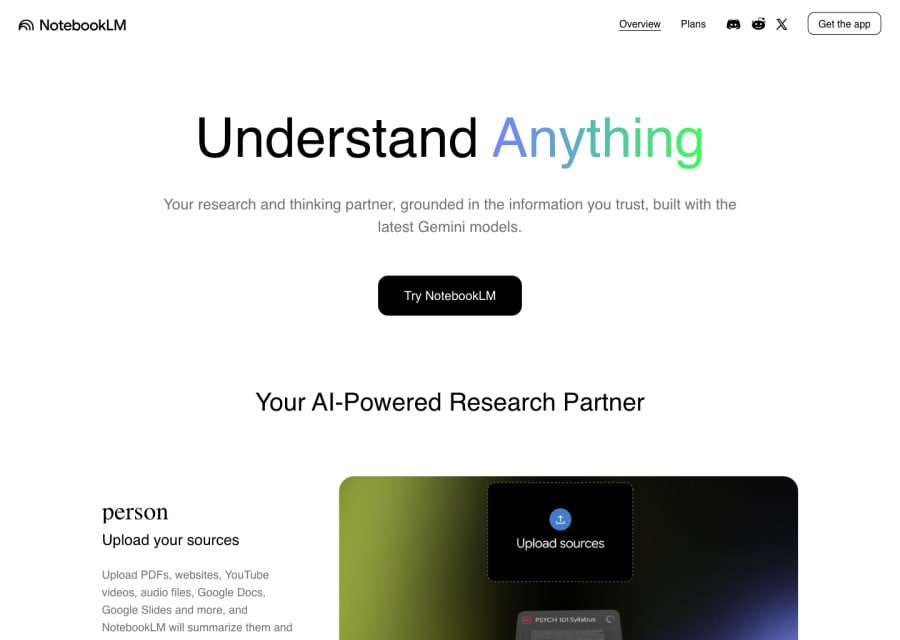
Claude leads on long-document reasoning with its 200K context window. NotebookLM excels for multi-document research with source citations. ChatGPT and Copilot for Microsoft 365 are strong for general-purpose summarisation within existing workflows.
How long can documents be?
Modern frontier models (Claude, GPT-4 class) handle 100K–500K tokens in one pass, equivalent to full books or medium-sized research corpora. If your document is truly massive (multi-thousand pages), chunking strategies or dedicated research tools handle it better than raw chat.
Can AI summarisers be trusted on critical documents?
Trust but verify. Modern tools are accurate on the substance but occasionally miss nuance, edge cases, or specific legal/financial language. For high-stakes documents (contracts, legal, compliance), use AI summaries as a starting point and always read the relevant sections yourself.
Do AI summarisers work on scanned or image-based PDFs?
Yes, the top tools include built-in OCR. Quality depends on the scan — clean documents work perfectly; faded or handwritten material is less reliable. For professional OCR needs (complex layouts, tables, forms), dedicated OCR tools before summarisation often produce better results.
Can AI summarisers handle research papers?
Yes, and academic-specific tools (Elicit, SciSpace, Consensus) outperform general tools for scientific literature. They understand paper structure (abstract, methods, results), can extract specific metrics, and handle multi-paper synthesis for literature reviews.